

The Hex of Hadley: A Tale of Mary Webster and Old Scratch
The year was 1684. In the small, struggling settlement of Hadley, Massachusetts, Mary Webster lived a life defined by quiet, often weary, virtue. Her husband had passed three years prior, leaving her with little more than a modest cabin, a few hardy hens, and a deep knowledge of the local flora.
She was poor, and in Puritan society, poverty often signaled a lack of God's enthusiastic favor. Yet, she was pious, diligent, and known for her soft hands that knew exactly which crushed herb would soothe a child's cough or stop a festering wound. Her faith was sincere, even if her life was harsh.
This very skill—her healing ability—became the poisoned seed of her undoing.
Her neighbor, Goody Eleanor Thorne, was a woman of vast opinion and venomous envy. Goody Thorne’s son, Seth Thorne, was a strapping, ambitious young man who, one damp autumn, suffered a sudden, inexplicable, and violent fever. Mary was called to cure him. She administered a decoction of willow bark and swamp root, and the fever broke.
However, the illness, or perhaps the remedy, left Seth with a permanent, slight tremor in his dominant hand. This flaw humiliated him, especially when he was trying to work the plough.
Goody Thorne, unwilling to blame Providence or her son’s weak constitution, chose the easiest, darkest narrative.
"It was the Widow Webster's potions! It was unholy! She saved his life, yes, but not before she cursed his hand!" Goody Thorne shrieked in the Hadley Meeting House, her voice laced with the self-righteous fury of a person desperate to deflect fault. "She drew on dark, un-Christian knowledge!"
The whispers began, carried on the frigid air like ash. Mary’s unusual knowledge of roots and simples, once a comfort, was now construed as proof of sinister communion.
Soon, all unexplained misfortune was laid at her door: a farmer's lame cow, a brewer's spoiled batch of ale, a child's nightmare.
Seth, ashamed of his tremor and eager to prove his manliness and piety, became the most vocal accuser, his handsome face slick with feigned outrage. He saw an opportunity to gain status by striking down the weak.
The accusations reached Boston. The warrant was served by constables—grim, official men who smelled of leather and stale seawater. Mary was hauled from her quiet life and marched the long miles east, her wrists bound by iron.
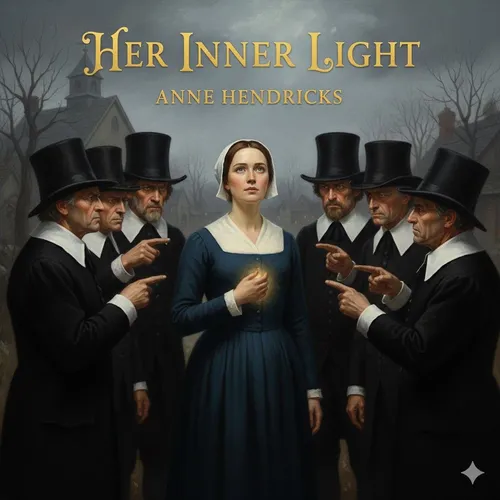
She stood before the Boston magistrates, accused of witchcraft. Her initial accusers, the Hadley neighbors, were joined by three pious, hysterical young women—professionals in religious dramatics—who shrieked and writhed, claiming Mary’s spirit tormented them.
“Look upon me!” the Head Magistrate commanded Mary. As she fixed her gaze on the young women, they collapsed into fits, thrashing on the floor. The crowd gasped, convinced of her guilt.
Yet, Justice Pembrooke, a rare skeptic on the panel, was wary of spectral evidence. He looked at Mary—a thin woman in homespun clothes, trembling with cold and fear—and saw terror, not malice. He looked at the accusers and saw only the theater.
"Show the court the mark of the Devil, if she is truly His own!" Justice Pembrooke demanded, his voice echoing in the packed chamber.
When nothing but the girls’ dramatics could be produced, and no witness could definitively claim Mary had physically harmed them, the court stalled. Frustrated by the lack of physical proof, Justice Pembrooke struck his gavel.
"The evidence is insufficient," he declared. "The accused is released."
Mary felt a dizzying surge of relief and dread. She had beaten the official law. But she knew the law of the village ran deeper, rooted in fear and neighborly resentment.
The journey back to Hadley was a solitary march of dread. As the sun set on her return, she saw the figures gathered near her cabin. They weren't constables; they were farmers, neighbors, men who sought a vigilante's justice.
A guttural roar erupted. "The law failed! The Devil protects his own!" At the head of the mob stood Seth Thorne, his face slicked with sweat and excitement. He carried a coil of thick hemp rope.
“You cheated the court, Mary!” Seth yelled, his voice cracking with righteous fury. “But you won’t cheat God! We won’t have the Devil’s spawn here!”
The mob surged forward, overwhelming her. They dragged her through the snow toward the old oak by the river, transforming the familiar landmark into an executioner's post.
They hanged her just as the moon rose, pale and indifferent, and then dispersed, convinced they had finished their work.
Mary hung alone in the frigid Massachusetts night. The rope, poorly tied, had not broken her neck. It choked her, a slow, agonizing suffocation. Her mind fractured, consumed by the crushing cold and the relentless, screaming injustice.
The innocent Mary Webster had been squeezed out of existence; all that remained was a vessel filled with pure, concentrated hate.
As the clock crept toward midnight, the air around the oak tree grew heavy, thick, as velvet saturated with iron. In the dead center of her misery, a voice—liquid and ancient—slid into the chasm of her despair.
"They call you a witch, Mary. Why disappoint them?"
The entity was not unseen; in the darkness, she sensed a colossal, patient shadow. She knew the name instinctively, the one whispered in fearful Puritan circles: Old Scratch.
He offered images of devastating revenge, of Seth’s ruin.
"I can make it swift. I can make it complete. Please give me that soul you are about to lose to the cold, Mary. It is already bruised and tainted by their cruelty. Please give it to Old Scratch, and the power that takes its place will be the scythe of your justice. You will live to see the last of them pay."
She thought of the years of quiet faith, hard work, and good intentions, all rewarded with this noose. Her will snapped. Yes. The silent, absolute affirmation resonated through the dark air.
The transfer was immediate and catastrophic. The pressure around her neck vanished, replaced by an intoxicating current of cold power that flowed through her veins.
The rope slackened, the knot dissolving into useless strands as if cut by an unseen blade. She slipped free, landing silently in the snow.
Mary stood, fully upright, no longer the meek Mary Webster of Hadley, but a vessel of malevolence, marked by the faint, livid ring of the hemp—the Devil's binding.
The cold fury had been transformed into dark, directed energy. The innocent woman was dead; the witch was bound to Old Scratch and demanded immediate payment.
Mary did not seek her cabin. She walked directly toward the village. The next morning, the villagers awoke to a scene of biblical terror. A suffocating, unnatural gloom clung to Hadley. Every well had turned the color of blood. The true horror lay in the vigilantes' homes.
Seth Thorne awoke to silence. His wife and three children lay still in their beds, their faces contorted in silent screams. A strange, brittle frost coated the inside of their bedroom walls, and a single, perfect crow feather—the signature of Old Scratch’s favor—lay on Seth’s pillow.
Panic erupted. The accusers were gripped by debilitating madness. The town sought a sacrifice and turned on the man who had led the lynching.
Seth was dragged before a hysterical mob. As the gallows were erected, Seth saw a figure emerge from the dense gloom—a woman, taller and darker than the Mary he remembered. Her eyes contained the indifferent, ancient cold of her new master. As the noose was placed around his neck, he saw her and understood the price of his own cruelty.
The rope tightened, and with his last breath, Seth choked out, “Mary, Mary, I am so sorry!”
His final sound was muffled, but Mary heard it perfectly. A faint, cold smile touched the corner of her lips. The initial contract was fulfilled. Old Scratch’s power was immense, and the first debt was paid in full.
Seth’s hanging was the catastrophic opening, but Mary's vengeance was not truly satisfied. She kept her existence a secret, letting her reputation do the heavy work. For the next thirty years, she became the haunting spirit of Hadley.
No sudden storms, no inexplicable illness, no blight that fell upon the Puritan harvest could occur without the villagers whispering, "It is the Hex of Old Scratch’s Witch."
She watched as the village that condemned her withered, not quickly, but slowly, generation by generation, eaten alive by suspicion and fear. She manipulated the elements, ruined marriages with subtle suggestions, and ensured no crop would thrive enough for true prosperity.
She never stepped into the light, but the shadow she cast was longer than any in New England. She lived in the satisfaction of her absolute, comprehensive power, a dark queen over a rotting kingdom.
Her face grew lined, but unnaturally preserved. Her eyes, however, grew heavier, weighed down not by age but by guilt. The good woman she once was fought tiny, losing battles in the dark recesses of her mind.
One bitter, moonless winter night, Mary felt a different kind of cold—a profound, terminal chill. She was sitting by her dying fire, watching the embers fade. She knew. The contract had been completed, and the time for final payment had arrived.
A shadow detached itself from the darkest corner of the cabin. It was not the great, roaring malevolence she had bargained with that night; it was subtle, familiar, and darkly genial.
A tall figure in a coat the color of dried blood stood before her, not threateningly, but patiently.
“Mary,” the voice purred, smooth as silk and cold as grave dirt. “A deal is a deal, and the time is met.”
Mary did not flinch. She had lived a long, cursed life, purchased with one desperate word on a gallows years ago. She finally saw the actual cruelty of Old Scratch: he didn't just take her soul; he forced her to witness the slow, agonizing death of the reasonable person she once was, all in the name of vengeance.
“I know,” Mary croaked, her voice dry as dead leaves. The regret was a dull, constant ache. She had wished only for justice; Old Scratch gave her a kingdom of ash. “I only wish I had been guilty the first time they hanged me. At least then, this debt would have been honest.”
Old Scratch smiled—a flash of brilliant white in the gloom. “Nonsense, Mary. You were always destined for this. They merely gave you motivation. And the payment, dear Mary, is now due. I have kept my end of the bargain. It is time for you to keep yours.”
As the cabin fire finally died, plunging the room into total darkness, the sound of an older woman’s frail body being dragged across the floor was muffled by the howling winter wind.
By dawn, the cabin was empty. Mary Webster, the first true Witch of New England, was gone, having finally made the ultimate payment to her dark master.
#MaryWebster #ColonialAmerica #Devil #Witches #ScaryStories #MargaretAtwood #HandmaidsTale











This story has not been rated yet. Login to review this story.