The year was 1634 when Anne Hutchinson arrived in Boston, a town newly carved out of the rocky Massachusetts wilderness. 


She was a woman of extraordinary intelligence, a sharp mind honed by years of theological debate in England. These attributes, coupled with her natural charisma, were not just rare in colonial women—they were inherently dangerous


Anne had faithfully followed her beloved minister, the revered John Cotton, but she brought with her a profound, personal theology—the concept of the Inner Light. This belief held that God's grace was communicated directly, a divine current flowing straight to the individual soul, rendering ministers, sermons, and rigid adherence to man-made laws as merely secondary aids.


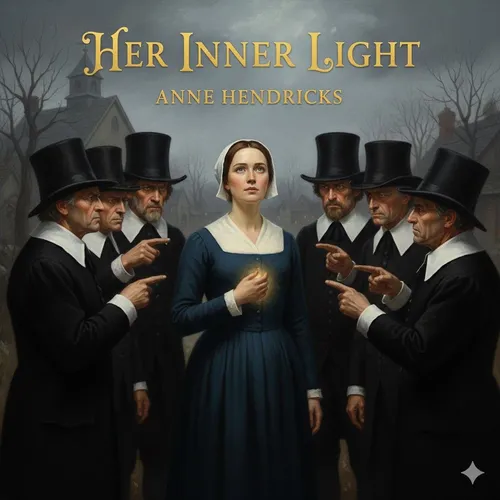
Anne began hosting twice-weekly meetings for the women of the settlement, ostensibly to discuss the Sabbath sermons. Within a year, the meetings swelled to include forty, then fifty attendees—including prominent men—and the focus shifted entirely to Anne’s intoxicating ideas. 


She taught that most ministers, focused solely on works and outward piety, preached the Covenant of Works, while only a few, like Cotton, truly preached the Covenant of Grace.


This distinction was a direct challenge to the authority of the ministers, who correctly saw their power—both spiritual and political—crumbling under the weight of her simple, revolutionary idea.


Among her most ardent admirers was Elizabeth Winthrop, the young, fiercely intelligent niece of Governor John Winthrop himself. Elizabeth, chafing under the oppressive monotony and severe demeanor of her uncle's rigid dogma, found an unexpected, liberating freedom in Anne’s parlor.


"My aunt says the spirit must be chained to the letter of the law, Mistress Hutchinson," Elizabeth confessed one afternoon, her voice hushed with revolutionary awe. "She says God only speaks through the ordained men."


Anne smiled, her eyes sharp and kind, like embers in the dark. "Then she knows only the shackles, child. The spirit of God is fire. Does one chain a fire? No one feeds it, respects it, and learns from its warmth. The Inner Light is within you, Elizabeth. Listen to it; it is the truest sermon you will ever hear, and it requires no pulpit."


This friendship, a bond of intellectual and spiritual equality, was Anne's most excellent comfort. Yet, in her youthful devotion, Elizabeth became the unwitting spy, relaying Anne's more radical critiques directly into the Governor’s household, poisoning the well of familial trust and providing the Governor with the intimate weapons he needed.


For three tumultuous years, Governor Winthrop endured the whispers, the swollen conventicles, and the growing political instability Anne’s teachings caused. He watched his "City on a Hill" consume itself in theological factionalism.


 He knew he had to crush her, not merely as a dissenter, but as an existential threat to the unity of Massachusetts Bay.


The tension finally broke when Governor Winthrop confronted his niece. He did not threaten her with mere banishment, but with a far more terrifying fate: the severance of her family, the destruction of her standing, and the scary, cold condemnation that Anne's teaching was a clever tool of Old Scratch designed to harvest the souls of the weak. 


The Governor's pressure, combined with the collective spiritual weight of the Puritan elite, proved too much. Elizabeth, heartbroken and terrified of eternal damnation, broke.


She appeared before the Council and testified against Anne. The words, extracted through guilt and fear, cut deeper than any theological argument. Elizabeth used intimate knowledge of Anne's private spiritual doubts and critical words about the ministers to frame her friend as a dangerous, arrogant vessel of dissent. 


The public betrayal was a calculated, devastating blow to Anne's moral credibility.The trial itself was a gruesome formality, spanning two days. Governor Winthrop personally presided, his face stern and unforgiving as he watched his former friend and his own niece exchange wounded, terrible glances across the courtroom. 


Anne defended herself brilliantly, out-arguing the ministers on their own theological ground, yet she could not defend herself against the power arrayed against her.


"You have deeply corrupted the people of God," Winthrop declared, his voice cold, final, and absolute. "You have set light against law, and grace against the necessity of order. You are a woman not fit for our society."

Anne, exhausted but defiant, finally spoke the words that sealed her doom: a prophecy of God's judgment upon the colony. "I know that the Lord will deliver me. You have no power over my life, nor any that depend on me, but what Christ Himself grants."


For this ultimate display of contempt for the secular authority of the court, the verdict was rendered. Anne was excommunicated from the church, and the sentence, delivered in the icy silence of the meeting house, was perpetual banishment. The Governor felt the unsettling sensation of justice, but his niece, Elizabeth, felt only the crushing weight of a heavy, irredeemable silence.


The banishment was a painful separation. Anne and William first journeyed south to Aquidneck (Rhode Island), a sanctuary of religious tolerance, but even there, Massachusetts's political reach created instability. 


They were refugees, not settlers. The cost of their freedom was immense: their older, married children, terrified of losing their standing and property, remained behind in the Bay Colony, making their own painful compromises. 


Anne bore that sacrifice like a physical weight, knowing that her spiritual vision had fractured her family.


After five years of unsettled life in Rhode Island, William, fearing New England’s creeping hostility, decided to move the family further south to the newly purchased Dutch territory of New Netherland. 

It was an arduous journey, fraught with illness, poor maps, and the ever-present danger of the wilderness.

They sought the Siwanoy River, a remote curve near what would become the Bronx, land they purchased from the local people.


The scent of pine and fresh water was a balm to Anne’s weary soul. They were building their own cabin, far from the Puritan gaze.


“Is this not better, William?” Anne asked, leaning against the sturdy frame of their half-finished cabin. Her husband, William, merely smiled, his face weathered but peaceful as he set down his axe.


“Freedom is always better, Anne,” he replied, wiping sweat from his brow. "Here, you may speak your mind, and the only overseer is God Himself. No meeting house, no Governor, no cousin's betrayal can reach us here."


She watched her younger children—William, Katherine, and little Susanna—laughing as they chased each other near the riverbank. Here, with the younger ones, Anne felt a profound sense of having rescued a fragile piece of her future. The year was 1643. She was finally comfortable, secure in the knowledge that her teachings of the Inner Light could breathe free.


That evening, the new moon was hidden by clouds. The silence of the wilderness, usually a comfort, felt vast and deep. Anne was inside, tending the hearth, while William stood sentinel near the open door, his hunting rifle resting against the jamb.


The attack, when it came, was not a battle, but a sudden, terrifying rush of noise and violence—a localized raid, part of what the Dutch would later call the Kieft’s War, driven by territorial encroachment and fear. William shouted once, a cry instantly choked by the sounds of shattered wood and splintering furniture. Anne grabbed the nearest poker, spinning around just as a figure burst into the cabin.


 There were more figures, their faces grim and painted, their purpose immediate and brutal.


Anne fell near the hearth, the last thought that registered being the flash of an uplifted tomahawk. 


The massacre lasted only minutes. When the raiders pulled back into the darkness, they took with them one small, screaming child: little Susanna.


The news traveled slowly. Settlers found the scene: the cabin a ruin, the bodies of Anne Hutchinson, William, and their children lying amid the carnage. They were buried quickly, and word was dispatched to the English colonies.


In Boston, Governor John Winthrop received the full, detailed report. He sat stiffly in his study, the document trembling slightly in his hands as he read the names of the dead. 


The fleeting image of his niece, Elizabeth, and the memory of their broken friendship, caused a cold, uncomfortable sensation. The Governor instantly crushed the momentary whisper of guilt, leaning back in his chair.


“The hand of God,” he murmured, the phrase settling over him like a cloak of icy righteousness. He took his heavy quill, dipped it deeply, and scrawled a note upon the margin of the official record: “Thus it pleaseth the Lord to lay this honor upon His own, that they might have cause to look the higher for His help.”


But as the earth settled over Anne's unmarked grave, her spirit did not ascend to a Puritan heaven, nor did the darkness of Old Scratch claim it. Instead, it lingered, rising above the dense pines and the gentle curve of the Siwanoy River, its presence a calm, brilliant warmth.


The spirit of Anne looked down upon the ravaged earth, then eastward, piercing the distance to the rigid, fearful city of Boston. The crushing pain of the physical world—the banishment, the agonizing betrayal by Elizabeth, the final violence—fell away, replaced by an overwhelming, serene certainty.


She saw not the dead children, but the future they would have built. She saw the generations to come, the seeds of the Inner Light she planted now growing in the hearts of the ordinary people.


She saw the inevitability of the freedom she preached taking hold, not through ministers and laws, but through the courage of individual conscience. She realized the true victory was not her survival, but the survival of her idea.


“My journey ends here, William,” her spirit whispered to the cold wind, her voice a soft, radiant presence among the trees. “The blood of our family is soaked into this land, and it will give life to the freedom we sought. My spirit of religious freedom goes on. My children, and the spiritual descendants of the Light, will build this country, unshackled and unafraid. I go on.”


The spirit ascended, not judged, but liberated, leaving behind a legacy not of heresy, but of transcendent, inevitable freedom—the true foundation of the new world.